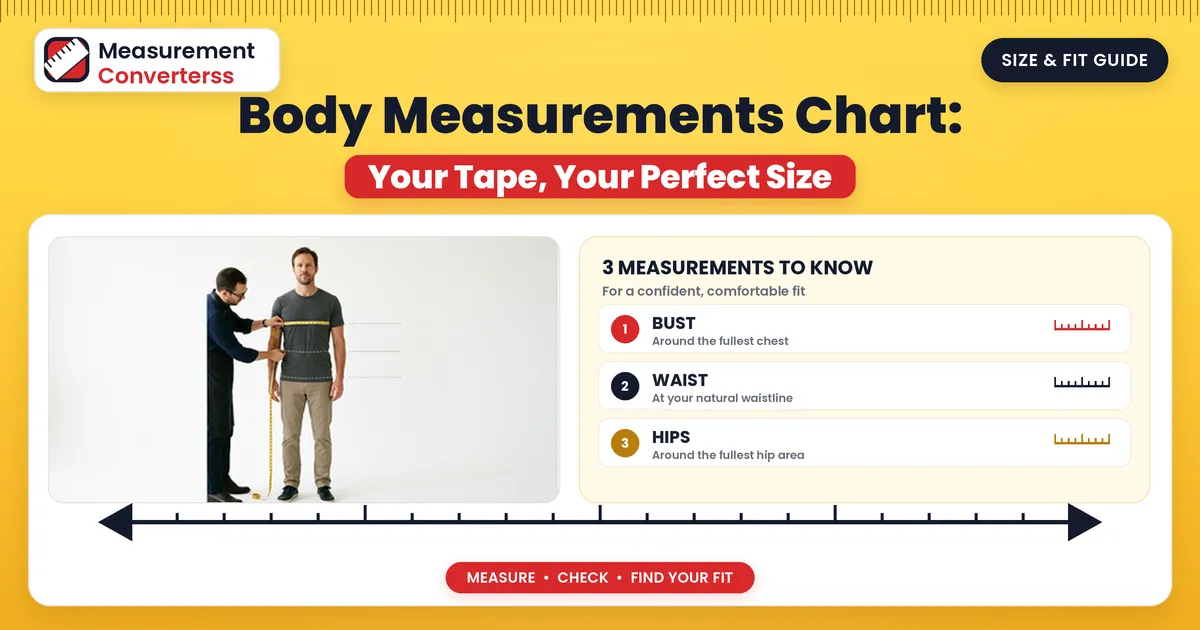
Body Measurements Chart: Your Tape, Your Perfect Size
This body measurements chart for men and women matches your bust or chest, waist, and hip measurements to US, UK, and EU sizes. You will learn how to measure yourself, read each size chart, and link your numbers to a body shape. We also cover average US body measurements and tools that track your results.
Table of Contents
Body Measurement Conversion: Inches, Centimeters, Feet, and Millimeters
Quick math helps when a body measurement chart lists one unit and your tape shows another.
1 inch equals 2.54 cm or 25.4 mm, and 1 foot equals 12 inches or 30.48 cm. Multiply inches by 2.54 to get cm, so a 36 in bust equals 91.4 cm.
Quick Reference List: What This Body Measurements Chart Covers
Here is everything you will find in this guide, grouped by topic.
- How to measure: bust or chest, waist, hips, height, shoulders, and inseam
- Women’s size chart: US, UK, and EU sizes, how to read them, and what to do between sizes
- Men’s size chart: chest, waist, and hip sizes, plus slim, classic, and loose fits
- Body shapes: hourglass, pear, triangle, apple, rectangle, inverted triangle, and spoon
- US averages: women’s and men’s measurements, plus waist-to-hip ratio ranges
- Tools: body shape calculator, dress size calculator, WHR calculator, and printable tracker
How to Take Your Body Measurements Accurately
Every body measurements chart is only as good as the numbers you bring to it.
How to Measure Your Bust or Chest
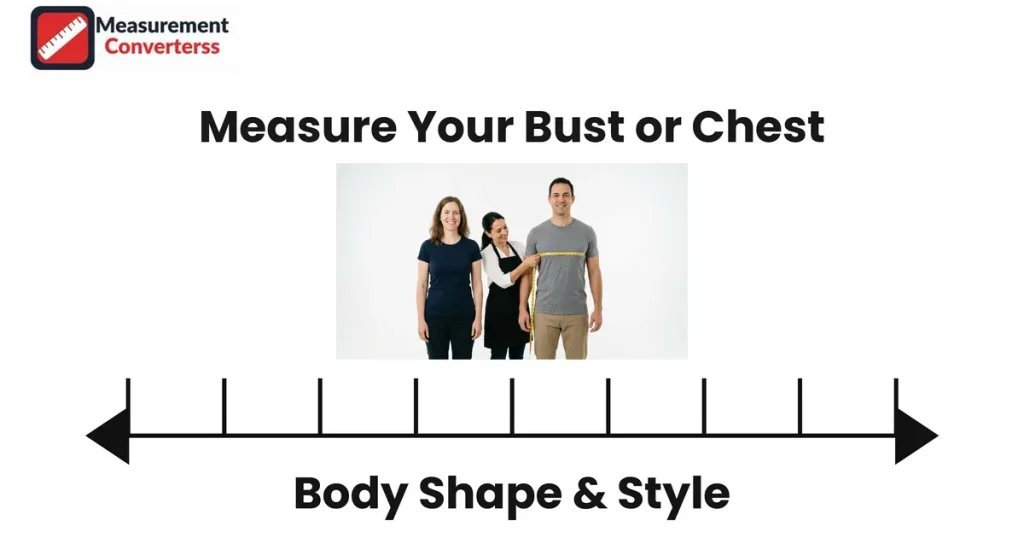
Wrap a soft Singer fiberglass tape measure around the fullest part of your chest, usually across the nipple line. Keep the Singer tape level and snug, but not tight.
Women should measure the bust in a non-padded bra or no bra. Men should keep arms relaxed so the Singer tape sits flat across the chest measurement.
How to Measure Your Waist (Natural Waist)
Find your natural waist by bending slightly to one side, where a crease forms. A Gulick Body Tape Measure should wrap around this narrowest point, about one to two inches above the belly button.
Breathe out normally and do not pull your stomach in. The Gulick Body Tape Measure has a spring-loaded end, which keeps the waist measurement consistent each time.
How to Measure Your Hips
Stand with your feet together and wrap the Singer soft measuring tape around the widest part of your hips and seat. The Singer tape must stay level all the way around.
Standing with feet apart can shrink the hip measurement by an inch or more. Check the Singer tape in a mirror so it does not dip at the back.
How to Measure Your Height
Stand barefoot against a wall with heels, back, and head touching it. Rest a flat hardcover book on your head and mark the wall under the book.
Measure from the floor to the mark with a Stanley PowerLock tape measure. Very tall? See how tall 2 meters is in feet and inches.
How to Measure Shoulders and Inseam (Optional Extras)
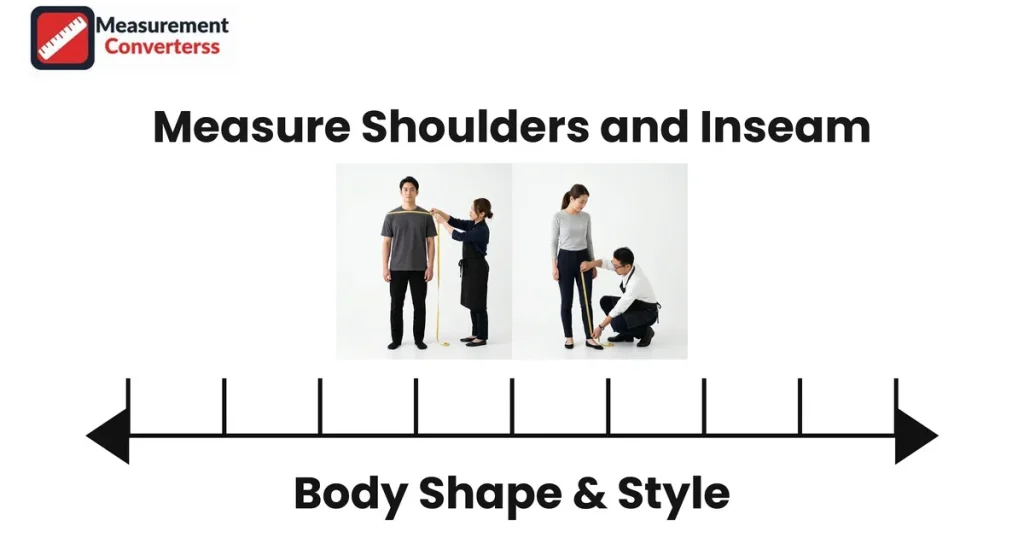
Measure shoulder width from the edge of one shoulder bone across the back to the other, using a Singer soft tape. Ask a friend to help, since this spot is hard to reach alone.
For inseam, measure from the crotch down to the ankle bone on a pair of well-fitting Levi’s 501 jeans laid flat. This gives a reliable trouser length number for men and women.
Women’s Body Measurements Chart (US, UK, EU Sizes)
Use this women’s body measurements chart to match your bust, waist, and hips to the right size in each system.
Women’s Bust, Waist, and Hip Size Chart (Inches and cm)
This women’s size chart lists typical bust, waist, and hip measurements for US, UK, and EU sizes. Brands vary, so treat the numbers as a guide.
| US Size | UK | EU | Bust (in) | Waist (in) | Hips (in) |
|---|---|---|---|---|---|
| 0 / XS | 6 | 32 | 31–32 | 23–24 | 33–34 |
| 2 / XS | 8 | 34 | 33–34 | 25–26 | 35–36 |
| 4 / S | 10 | 36 | 35–36 | 27–28 | 37–38 |
| 6 / S | 12 | 38 | 37–38 | 29–30 | 39–40 |
| 8 / M | 14 | 40 | 39–40 | 31–32 | 41–42 |
| 10 / M | 16 | 42 | 41–42 | 33–34 | 43–44 |
| 12 / L | 18 | 44 | 43–44 | 35–36 | 45–46 |
| 14 / L | 20 | 46 | 45–46 | 37–38 | 47–48 |
| 16 / XL | 22 | 48 | 47–48 | 39–40 | 49–50 |
Multiply any inch value by 2.54 to see it in cm, so a 35 to 36 in bust equals about 89 to 91 cm. A US size 4 or UK size 10 sits in the same row.
How to Read a Women’s Size Chart
Find the row that matches your bust, then check that your waist and hips fall in the same row. A woman measuring 36-28-38 fits a US size 4 on this women’s size chart.
Read each column on its own, since women’s body measurements rarely land in one row. The waist column often decides fit for pants and skirts.
What to Do If You Fall Between Two Sizes
When your numbers land in different rows, pick the size that fits your largest measurement. A woman with a 36-inch bust and 40-inch hips should start with a US size 6 in Levi’s 501 jeans.
A tailor can take in a waist for a small fee, but it is hard to let out a tight hip. Choose a stretch fabric if your women’s body measurements sit between two sizes.
Men’s Body Measurements Chart (Shirt and Trouser Sizes)
This men’s body measurement chart compares chest, waist, and hip numbers with standard US sizes from XS to 3XL.
Men’s Chest, Waist, and Hip Size Chart (Inches and cm)
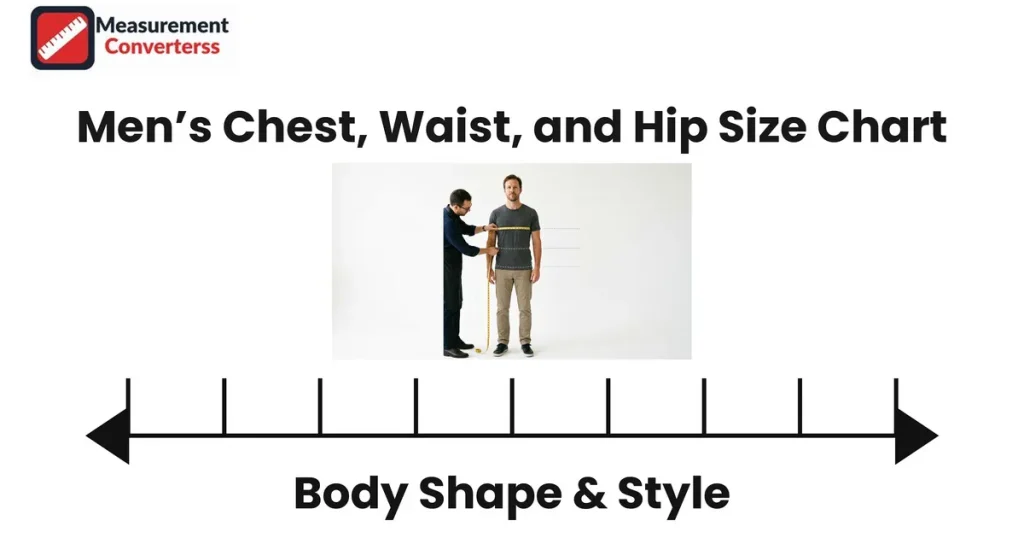
The men’s size chart below lists common chest, waist, and hip measurements for shirts and trousers. Brand cuts differ, so check each label.
| Size | Chest (in) | Waist (in) | Hips (in) |
|---|---|---|---|
| XS | 32–34 | 26–28 | 33–35 |
| S | 35–37 | 29–31 | 36–38 |
| M | 38–40 | 32–34 | 39–41 |
| L | 41–43 | 35–37 | 42–44 |
| XL | 44–46 | 38–40 | 45–47 |
| 2XL | 47–49 | 41–43 | 48–50 |
| 3XL | 50–52 | 44–46 | 51–53 |
A man with a 40 in chest wears a medium in most men’s shirt sizes. Multiply by 2.54 to get cm, so 40 in equals about 102 cm.
How to Choose a Size When You’re Between Two Sizes
If your chest measurement sits in one size and your waist in another, buy the larger size. A man with a 42 in chest and 34 in waist should pick a large Hanes Beefy-T.
Shirts are easy to tailor at the waist, but a tight chest limits movement. For men’s trouser sizes, use the waist number and ask a tailor to adjust the rest.
Fit and Ease: Slim, Classic, and Loose Fits
Ease is the extra room a garment gives beyond your body measurements. A classic-fit Nike Dri-FIT shirt usually adds 2 to 4 inches over your actual chest size.
Slim cuts add little or no ease, while loose cuts add 4 to 6 inches or more. Check the Nike Dri-FIT size guide to see how much room each style gives.
Body Shape from Your Body Measurements
Your body measurements chart numbers also reveal your natural proportions and body shape.
Hourglass Body Shape
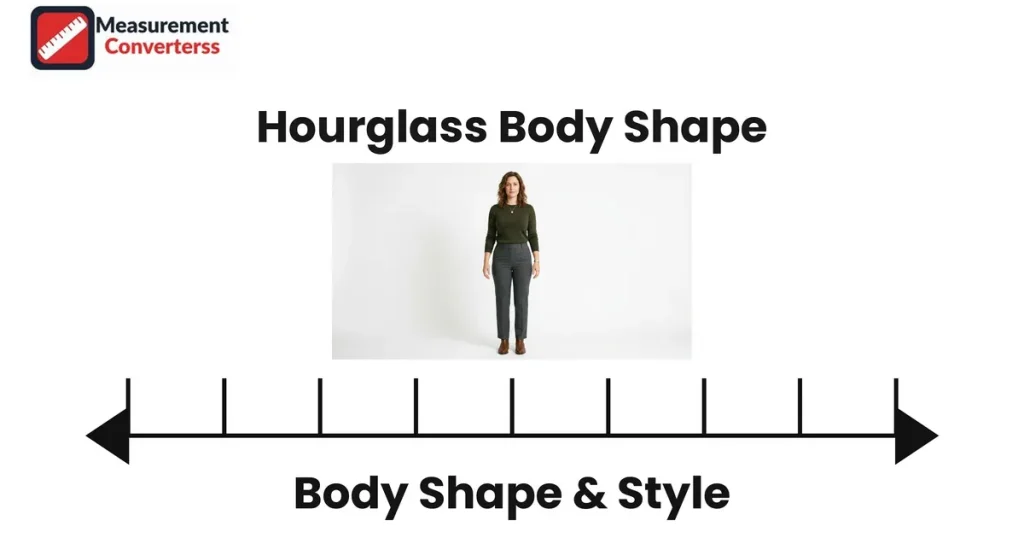
An hourglass body shape has bust and hip measurements that are almost equal. A clearly smaller waist links them, as in 36-24-36.
The hourglass is rare, since only about 8 percent of women fit it in a 2005 North Carolina State University study of 6,000 women. Hourglass bodies usually need clothes that follow the waistline.
Pear Body Shape
A pear body shape has hips that are about 5 to 15 percent wider than the bust, with a defined waist. A sample set is 34-27-39.
Pear shapes carry weight in the hips and thighs. In the same North Carolina State study, just over 20 percent of women had a pear shape.
Triangle Body Shape
A triangle body shape has hips more than 15 percent wider than the bust, such as 34-28-40. The waist can look defined or soft.
The triangle differs from the pear because the hip gap is bigger. Triangle shapes often balance proportions with structured shoulders and light-colored tops.
Apple Body Shape
An apple body shape carries weight in the midsection, with a waist that is 90 percent or more of the bust, as in 38-36-39. Bust and hips are similar.
About 14 percent of women in the North Carolina State study had an apple shape. This shape is also linked to a higher waist-to-hip ratio.
Rectangle Body Shape
A rectangle body shape has bust, waist, and hips that sit within a few inches of each other, like 36-30-37. The waist is not strongly defined.
This is the most common body type, since 46 percent of women in the North Carolina State study were rectangle-shaped. Rectangle shapes often add curves with belts and layered tops.
Inverted Triangle Body Shape
An inverted triangle body shape has a bust or shoulders at least 5 percent wider than the hips, for example, 40-32-36. The waist can vary.
Many athletes have an inverted triangle frame, including swimmers and rowers. For men, the same shape appears as the V-taper, where the chest is wider than the hips.
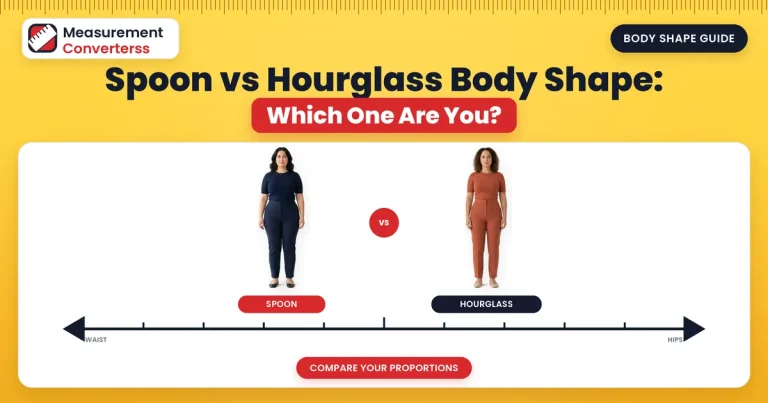
Spoon Body Shape
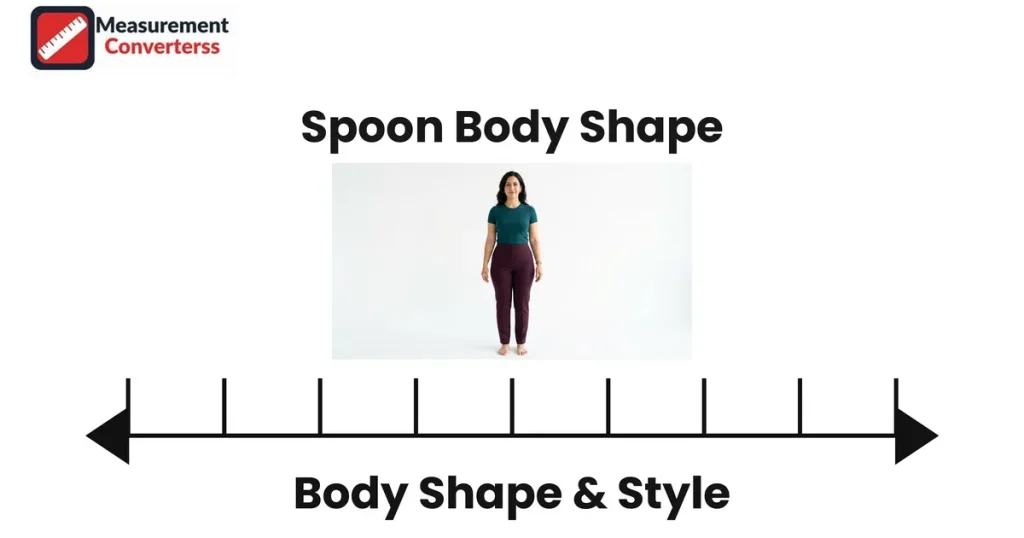
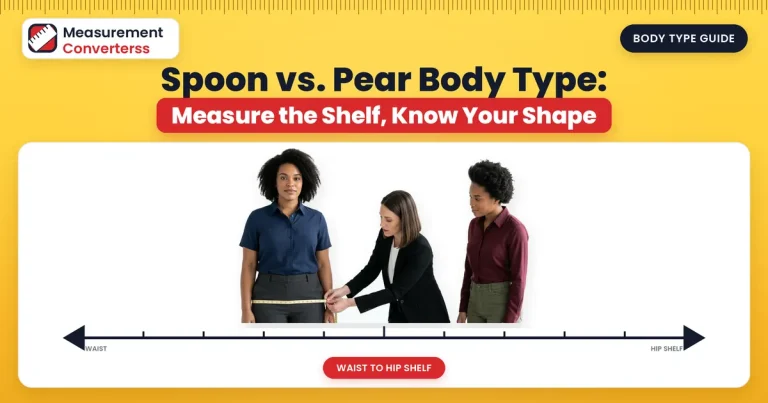
A spoon body shape has hips wider than the bust and a high “hip shelf” that sticks out just below the waist. A sample set is 34-27-40 with a high hip of 35.
The spoon shape differs from the pear because the high hip measures at least 15 percent wider than the waist. Taking a high hip measurement about 7 inches below the waist reveals it.
Average Body Measurements in the USA
These figures are general references only, so rely on your own body measurements chart results for sizing.
Average Women’s Measurements in the US
The typical US woman has a bust of 38 to 40 inches, a waist of 34 to 36 inches, and hips of 41 to 43 inches. Average height is around 5 ft 4 in.
Her typical US dress size is 16 to 18. Individual women’s body measurements vary widely with age, height, and build.
Average Men’s Measurements in the US
The typical US man has a chest of 41 to 43 inches, a waist of 36 to 40 inches, and hips of 40 to 42 inches. Average height is about 5 ft 9 in.
His usual shirt size is large to extra-large. Individual men’s body measurements shift with muscle mass, age, and frame.
Waist-to-Hip Ratio (WHR) Reference Ranges
Waist-to-hip ratio is your waist divided by your hips, so a 34 in waist and 40 in hips equals 0.85. The National Institute of Diabetes and Digestive and Kidney Diseases says higher health risk starts above 0.8 for women and 1.0 for men.
Many fashion references treat 0.65 to 0.75 as an hourglass range and 0.85 and above as apple-like. Use WHR as a health reference, not a measure of your worth.
Why Your Own Measurements Matter More Than Averages
The average body measurements in the US describe a crowd, not you. A woman with a 34-inch bust is just as normal as one with a 40-inch bust.
Brands cut clothes for fit models, not for national averages. Your own body measurements chart numbers will always predict fit better than any population figure.
Body Measurement Tools, Calculators, and Printable Trackers
The right tool turns your body measurements chart results into a personal size and shape answer.
Body Shape Calculator
A body shape calculator takes your bust, waist, and hip numbers and sorts them into a shape such as hourglass or pear. Some versions also ask for a high hip number to spot the spoon shape.
Enter measurements taken with a Singer soft tape measure for the cleanest result. A body shape calculator gives a fashion guide, not a health diagnosis.
Dress Size Calculator
A dress size calculator converts your bust, waist, and hip numbers into US, UK, and EU dress sizes. This saves time when you shop across several sizing systems.
Use the results as a starting point, then compare them with the brand’s own size chart. A dress size calculator cannot account for brand-specific cuts.
Waist-to-Hip Ratio Calculator
A waist-to-hip ratio calculator divides your waist by your hip measurement and shows the result as a single decimal. The World Health Organization flags a WHR above 0.90 for men and 0.85 for women.
Take both numbers with a Gulick Body Tape Measure so the tape pressure stays steady. A WHR calculator works best when you track the result over time.
Printable Body Measurement Chart for Tracking Progress
A printable body measurement chart gives you a page to log your bust, waist, hips, and thighs over time. It also helps you measure the same spots every session.
Many people measure every 2 to 4 weeks, in the morning before eating. A body measurement tracker shows progress that the bathroom scale can miss.
Conclusion
A body measurements chart is only as accurate as the numbers you bring to it, so measure your bust or chest, waist, hips, and height with care. Compare your results with the women’s or men’s size chart, and always check each brand’s own guide before ordering. Then use a calculator or printable tracker to turn your measurements into a personal fit.
Frequently Asked Questions
What are standard body measurements?
Standard body measurements are bust or chest, waist, and hips. Measure each at its fullest, narrowest, or widest point.
How do I read a body measurements chart?
Find the row that matches your bust, waist, and hips. If they differ, choose the size that fits your largest measurement.
What are average body measurements for US women?
US averages are about 38 to 40 in bust, 34 to 36 in waist, and 41 to 43 in hips. Individual numbers vary widely.
What is the difference between body measurements and dress size?
Body measurements are real inches or cm, while dress size is a brand-assigned label. Since brands differ, your measurements are more reliable.
How do body measurements determine body shape?
Body shape depends on how your bust, waist, and hips compare. Balanced bust and hips with a smaller waist suggest an hourglass.
How often should I measure myself?
Measure every 2 to 4 weeks if you are tracking progress. Use the same spots and the same time of day.